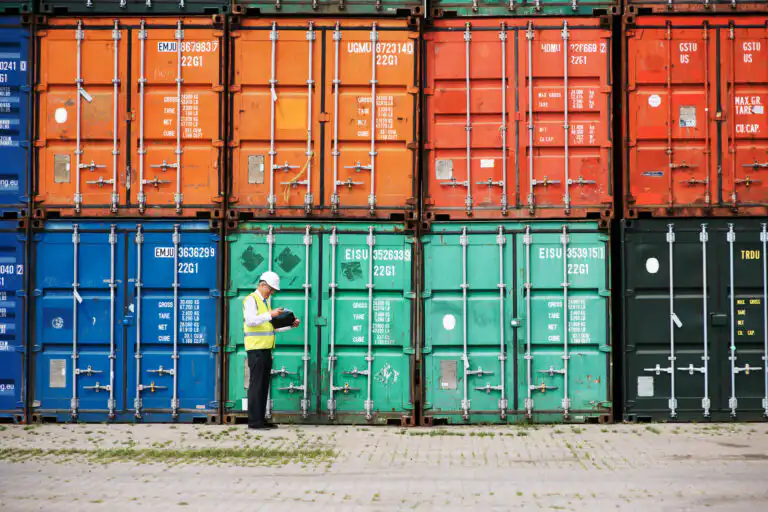

A truck sits at Dover, hours from delivery, turned away because of a single incorrect digit on the HS code. The customs filing itself cost about £48. The delay will cost thousands.
This is the shape of post-Brexit customs documentation for UK-EU trade: a workflow where the price of getting a form wrong costs far more than getting it right. Five years after Brexit, the documentation set is broader, more interconnected, and stricter than anything forwarders dealt with before 2021 — with greater volume, higher data-quality demands, and less room for error.
The Brexit impact: two systems, twice the paperwork
Before 2021, a UK forwarder moving goods to or from the EU operated within a single customs union, and intra-EU movements didn’t require a customs declaration. Brexit replaced that with two separate regulatory environments that have continued to diverge.
The volume effect has been substantial. By 2025, UK businesses were filing around 91 million cleared customs declarations annually, nearly 41 million between GB and the EU alone, according to HM Revenue and Customs (HMRC)’s official statistics. UK-EU goods trade remains well below pre-2020 levels, partly because of this added friction.
Three things in particular shape the forwarder’s day-to-day:
- Two EORIs, one shipment. UK-EU trade can require both a UK and an EU EORI number on the same shipment, depending on who’s acting as importer.
- Two safety systems, two filings. Goods moving between GB and the EU now need safety and security declarations on both sides, under the UK’s Border Target Operating Model (BTOM) heading one way, and Import Control System 2 (ICS2) heading the other.
- Preferential origin claims. Zero tariffs under the Trade and Cooperation Agreement (TCA) only apply if goods meet origin rules and the paperwork proves it. Get the claim wrong, and the importer pays full duty.
The net effect is that every UK-EU shipment now generates roughly twice the document work it did before Brexit.

The documentation stack got deeper, not just bigger
Volume is only a part of the story, as the documentation set itself has become broader and more interconnected. An average international shipment now generates over 50 documents, including declarations, certificates, and reconciliations. These include the commercial invoice, packing list, customs declaration, safety and security declaration, rules of origin documentation, transport documents, and, for agrifood and other regulated categories, product-specific certificates such as Export Health Certificates and phytosanitary documents.
According to HMRC’s 2022 customs administrative burden study, UK businesses incurred £1.8 billion in administrative burden for GB-EU trade declarations that year, amounting to a £48-per-declaration cost aggregated across 37 million shipments.
The real challenge is the interconnection. An EORI mismatch between the invoice and the Entry Summary Declaration (ENS) results in the shipment being queried. A weight discrepancy between the packing list and the transport document triggers a hold. Each document is manageable on its own; the reconciliation across all of them is where the workload sits.
The operational impact: where the documentation burden actually hurts
Cross-Channel and short-sea routes between GB and the EU run on a tight clock measured in hours. If documentation is still being keyed into the declaration system when the truck arrives at the port, the booking is missed.
What forwarders consistently report is that document preparation, not transport, is the bottleneck. And the cost of a mistake doesn’t always show up at the border. A shipment can clear the border cleanly and still cost you six months later, when a post-clearance audit surfaces a mismatched HS code, invalidates a preferential origin claim, and re-exposes the importer to full duty. By then, the original mistake is buried under six months of subsequent shipments.
The burden also falls disproportionately on SMEs. According to European Central Bank research, 77% report Brexit compliance costs exceeding 10% of their operating budgets, which has effectively forced them to outsource customs handling. The customer base for forwarders has grown as a result, but the customers themselves are more cost-sensitive and time-pressured, squeezing margins.

How forwarders are adapting
The forwarders scaling through this without adding headcount have stopped treating documentation as an administrative task.
Three patterns are showing up consistently:
- Automated ingestion at the front of the workflow. Source documents are delivered via email, EDI, the customer portal, or a carrier system and automatically routed to an extraction layer. At one large European forwarder PayCargo works with, 80% of inbound requests arrive with attachments, and 99% look different. Commercial invoices with 100-plus commodity lines that used to take 2 to 3 hours to key in are now processed in 2 to 3 minutes. Automation platforms such as PayCargo’s Document Automation sit at this layer, bridging unstructured PDFs with the structured data that UK and EU customs systems expect.
- Exception-based human review. Rather than every document being keyed by hand, only the fields that fail a validation rule or fall below a confidence threshold get human attention. The operator’s job changes from “process 100 documents a day” to “review 15 flagged fields a day.” That’s where the throughput gain comes from.
- Cross-document reconciliation built into the process. Because the post-Brexit pain point lies in the interconnection between documents, the forwarders getting genuine ROI are those whose systems automatically check the commercial invoice against the packing list, against the transport document, and against the declaration draft before anything is submitted. Catching a 5 kg weight discrepancy at intake is cheap. Catching it after the ENS has been filed is not.
The bottom line
Brexit added paperwork and restructured the documentation set at exactly the moment both regulatory regimes tightened their data quality requirements. The technology to handle it exists, the compliance pressure is immediate, and the competitive question is which forwarders build the workflow now, and which keep absorbing the cost of getting it wrong.